App price ranges vary wildly. Here is what really drives the cost, four ways to build from lowest risk to highest cost, store fees and upkeep, and how to get a real number for your idea.
How much does it cost to build an app? Published agency guides commonly put a simple app at about $15,000 to $50,000, a mid-level app at $50,000 to $120,000, and a complex platform at $120,000 to $300,000 or more. Those are one agency's 2026 figures. Another US agency quotes $40,000 to more than $600,000.
Ranges that wide do not help you plan, and agencies have a commercial interest in the numbers they publish. The more useful question is which of those brackets your idea really belongs in, and whether you need a traditional app at all. That decision can change your budget more than any hourly rate.
What actually drives the price
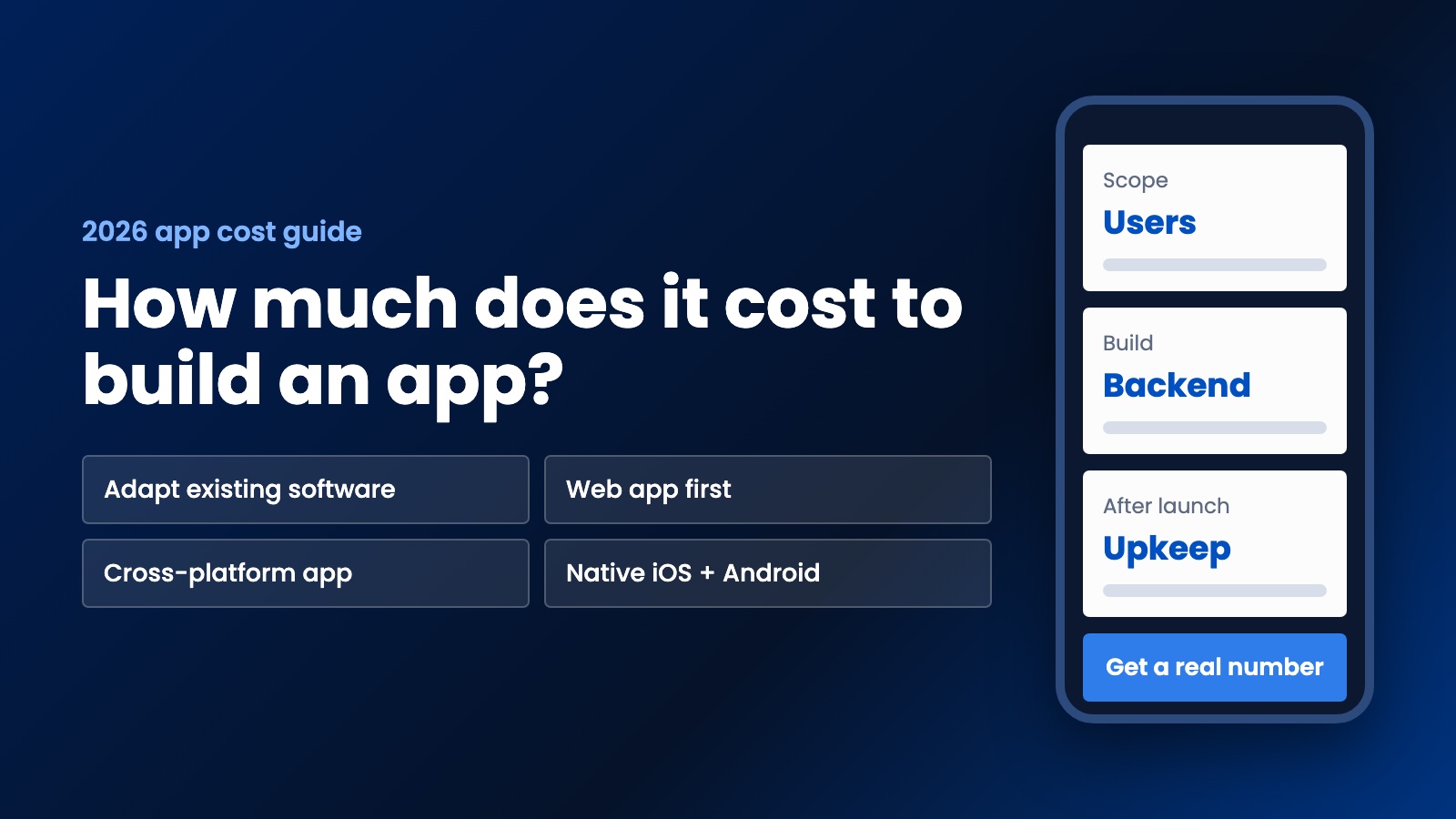
Screens are the visible part of an app, but they are rarely the expensive part. These five things usually matter more:
- The number of user roles. One type of user is simple. A marketplace with customers, vendors and admins is effectively three products that must stay in sync.
- The backend. Accounts, permissions, payments, notifications and reports all live on a server you do not see. For business apps, this is often where most of the work sits.
- Integrations. Each connection to a CRM, accounting system, payment provider or map service adds design, testing and something else that can change later.
- Offline use and real-time data. Live tracking, chat and working without a connection all add real complexity.
- Rules you must follow. Apps that handle health or financial data need more care around security, audit trails and access, and that takes time to build and test.
Four ways to build, from lowest risk to highest cost
Most cost guides assume you want a custom app in both stores. That is only one option, and often not the right first step.
1. Adapt software that already exists
If your need is common, such as clinic management, inventory, point of sale or field tracking, you may not need to start from nothing. Tailoring a working product gets you to real users faster, because the core has already been built and used. This is how we prefer to start when it fits. Our ClinicOS clinic management software is one example, with a web system and Android and iOS apps.
2. Start with a web app
A web app works in the browser, so there is nothing to install and only one version to update. A progressive web app can reach any device from a single codebase and can be launched from the home screen. It suits internal tools, client portals and early products where you are still testing the idea. It is usually a weaker fit when you depend heavily on device features or need to be found in the app stores.
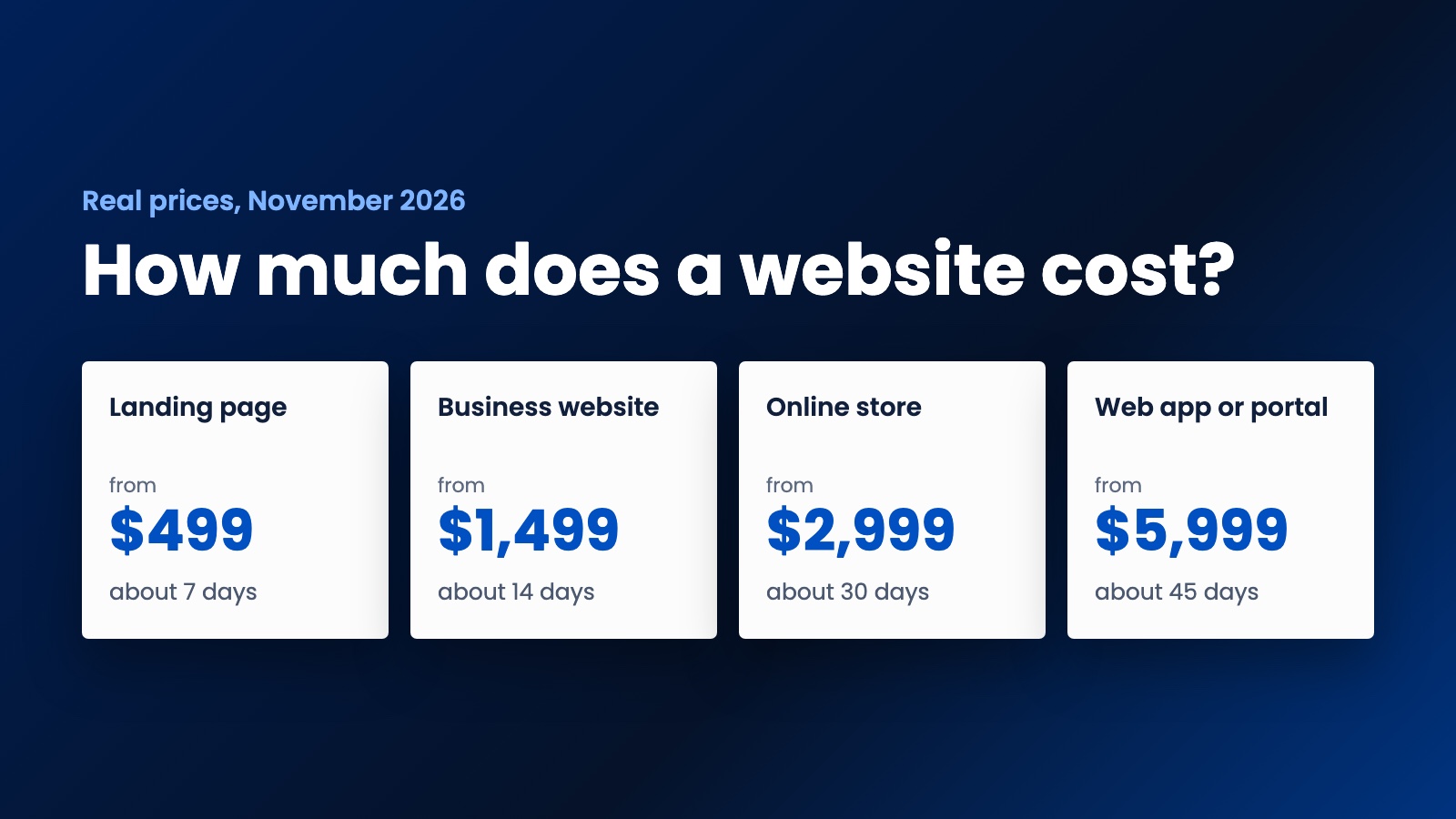
This is the one level where we publish a starting price: a web app or client portal starts from $5,999 and takes about 45 days. For example, our cost calculator estimates a portal with CRM integration and an AI chatbot at $6,500 to $8,650, in about 55 days. That is a web app, not a native mobile app.
3. Build one cross-platform app
Frameworks such as Flutter and React Native let one codebase run on both iOS and Android. For most business apps, that means you build and maintain less than you would with two separate apps. Some device-specific work is still needed, so ask how much of the code will really be shared.
4. Build separate native apps
Separate iOS and Android apps give you the deepest access to each platform, but you are maintaining two codebases. That can be worth it for demanding graphics, advanced device features or an app that is itself your core product. Most small and mid-sized businesses should need a strong reason to start here.
The costs after launch that catch people out
The build is only the first bill. Add these before you compare quotes:
- Store accounts. The Apple Developer Program costs $99 per membership year, and Google Play charges a one-time $25 registration fee.
- Store commission. If you sell digital goods in the app, the stores take a share. Apple's Small Business Program charges 15% for eligible developers earning up to $1 million a year. Google Play's fee is also 15% on the first $1 million of yearly revenue in its standard tier, with rates that vary for subscriptions and by region. Check the current terms before you set your pricing.
- Maintenance. New phone operating systems, security patches and bug fixes do not stop. One agency estimates 15% to 20% of the build cost each year. Treat that as a planning figure and ask your developer for their own.
- Servers and third-party services. Hosting, push notifications, text messages, maps and email usually grow with your usage. Ask for an estimate at 1,000 users and at 10,000.
- Getting users. A published app does not find its own audience. If it depends on public downloads, budget for marketing from the start.
Five ways to reduce the cost without hurting the product
- Write the one job the app must do. If you cannot state it in a sentence, you are not ready for a quote.
- Launch with one user role if you can. Run the other side manually at first, using a simple admin screen or even a spreadsheet.
- Buy what is not unique. Payments, login and messaging are solved problems, so use established services.
- Prove demand first. A landing page or a web version can show whether people want this before you pay for two app store releases.
- Pay in milestones. You see working software as you go, and you can change direction before the budget is gone. We split our own projects this way.
Questions to ask any app developer
- Which of the four routes above would you choose for this, and why?
- What does your estimate leave out?
- Who owns the code, and how do I get it if we stop working together?
- Can I talk to someone about an app you still maintain?
- What will it cost me per year to keep this running?
Be careful with any fixed price given before someone has asked about your users, data and integrations. They cannot know those costs yet, so that price may be padded or may change later.
How to get a real number for your idea
You do not need a full specification. Write down who will use the app, the main thing each person must do, what it has to connect to, and your deadline. With that, a good team can tell you which route fits and give you a realistic figure.
We build business software with Android and iOS apps, from tailored products to systems built from scratch. Send us your idea and we will reply with a recommended route and a clear price before any work starts.
Need help putting this into practice?
Our team can do it for you — a clear plan and price within 24 hours, no obligation.