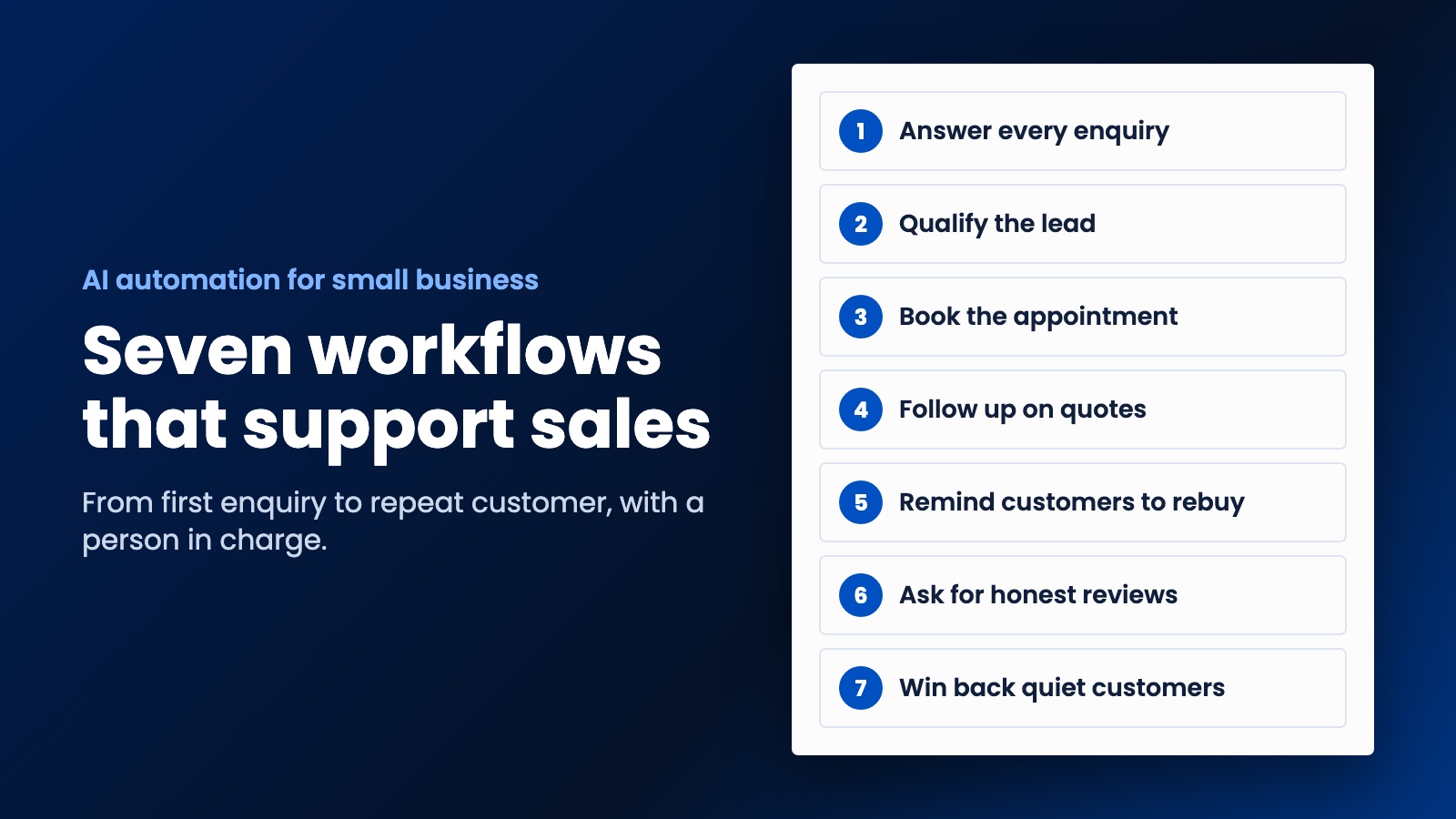
Seven AI automation workflows that support sales, from answering every enquiry to winning back quiet customers, plus what to keep human, the rules to check and how to measure results.
AI automation for small business is most useful in one place: the gap between someone showing interest and someone paying you. Enquiries arrive after hours, quotes go unanswered, and past customers forget you exist. None of that requires a clever new strategy to fix. It requires consistent follow-through, and that is exactly what automation is good at.
You do not need a data science team or a huge system. You need a few workflows, each with one clear job, connected to the tools you already use. Here are seven that directly support sales, in the order we would usually build them.
Seven AI automation workflows that support sales
1. Answer every enquiry straight away
An AI assistant trained on your services and policies can answer common questions on your website or WhatsApp at any hour. The rule that makes this work is that it answers only from information you approve, and hands over to a person when it is unsure. A customer who gets a useful reply at 9 p.m. has less reason to keep searching.
2. Qualify leads and fill in your CRM
Instead of a form that collects a name and nothing else, the assistant can ask what the person needs, when they need it, and where they are. It then adds a tidy record to your CRM or spreadsheet and flags the serious ones. Your sales time then goes to the people most likely to buy.
3. Book the appointment
Every extra message between "I'm interested" and a confirmed time is a chance to lose someone. When a lead is ready, the system can offer open slots, book the call, and send reminders so that fewer people forget to show up.
4. Follow up on every quote
Many quotes end in silence, and often that is because the customer got busy rather than because they said no. An automated sequence can check in after a few days, answer common objections, and stop as soon as the person replies. This is often the simplest sales win, because the lead has already shown interest. Our roofing website build follows up on each estimate this way.
5. Remind customers to buy again
Some products run out and some services repeat. A reminder at the right moment, with a one-click link to rebook or reorder, makes the next sale easy. Our cleaning website build does this after every job, and our online store build uses the same idea for reorders and abandoned carts.
6. Ask for reviews and referrals
The best time to ask is just after a job goes well, and that is the moment a busy team tends to forget. Automating the request makes it happen every time. Keep it honest, though: ask for genuine feedback, and never use AI to write reviews. The US FTC rule on fake reviews explicitly covers AI-generated ones.
7. Win back quiet customers
Someone who has not bought in a while already knows you. A personal message based on what they bought before is easy to send and can restart the relationship. AI helps here by drafting messages that fit each customer's history, while your rules decide who gets one and when.
Where to begin with AI automation for small business
Do not try to build all seven at once. Pick one by asking three questions:
- Where do you lose the most sales today? Missed calls, slow quotes and forgotten customers each point to a different workflow.
- What do you already repeat every day? If your team types the same answers daily, the training material already exists.
- Can you measure it? Choose something you can count, such as replies, booked calls or repeat orders.
Run that one workflow for a few weeks, compare against your numbers from before, and only then add the next. Automating a broken process just breaks it faster, so write down how the process should work first.
What you should not hand to AI
A good system knows where it stops. We build in human review where it matters, and we would keep people in charge of:
- Prices and promises outside your approved list. Customers may hold you to what your assistant said.
- Complaints and upset customers. Pass these to a person quickly.
- Legal, medical and financial advice. The assistant can book the appointment, not give the advice.
- Large or custom deals. AI can prepare the details, and your team should close them.
Also, check what happens to your data. Before you connect customer records to any tool, find out where the data is stored, who can access it, and whether it is used to train models.
The rules to check before you switch it on
Sales automation contacts real people, so there are rules. These vary by country and change over time, so get advice for your situation. This is general information, not legal advice, but here are three examples of what to look for:
- AI phone calls in the US. The FCC has ruled that AI-generated voices count as "artificial" under the TCPA, so these calls generally need the person's prior express consent.
- Chatbots in the EU. Under the AI Act's transparency rules, which apply from August 2, 2026, people should be told they are talking to AI unless it is obvious. Telling customers is good practice everywhere anyway.
- Marketing messages. Email and text marketing have consent and opt-out rules in many places, including the UK, EU, US, Canada and Australia. Keep a record of consent and make unsubscribing easy.
How to tell if it is working
Hours saved are nice, but sales automation should be judged on sales. Track these before you start and every month afterward:
- How quickly each new enquiry gets a first reply.
- The share of enquiries that become booked calls or quotes.
- The share of quotes that become customers.
- Repeat purchases from existing customers.
- Conversations handed to a person, and why.
Read a sample of real conversations each week as well. You will quickly spot wrong answers, and you will also find out what customers are really asking, which is useful for your website and your sales team.
Common mistakes
- Buying a tool before choosing a problem. Start with the sale you are losing.
- Pretending the bot is a person. It damages trust once people notice.
- No way to reach a human. This is often what customers complain about first.
- Too many messages. Automated follow-up should stop the moment someone replies or opts out.
- Set and forget. When your services change, your assistant's information has to change too.
Get help building yours
Most small businesses already own the tools they need, so the work is usually connecting them properly. Our AI automation service starts with the tasks that cost you the most, builds around the software you already use, and keeps a human in the loop where it matters. See what we automate, then tell us how you work and we will reply with a clear plan.
Need help putting this into practice?
Our team can do it for you — a clear plan and price within 24 hours, no obligation.